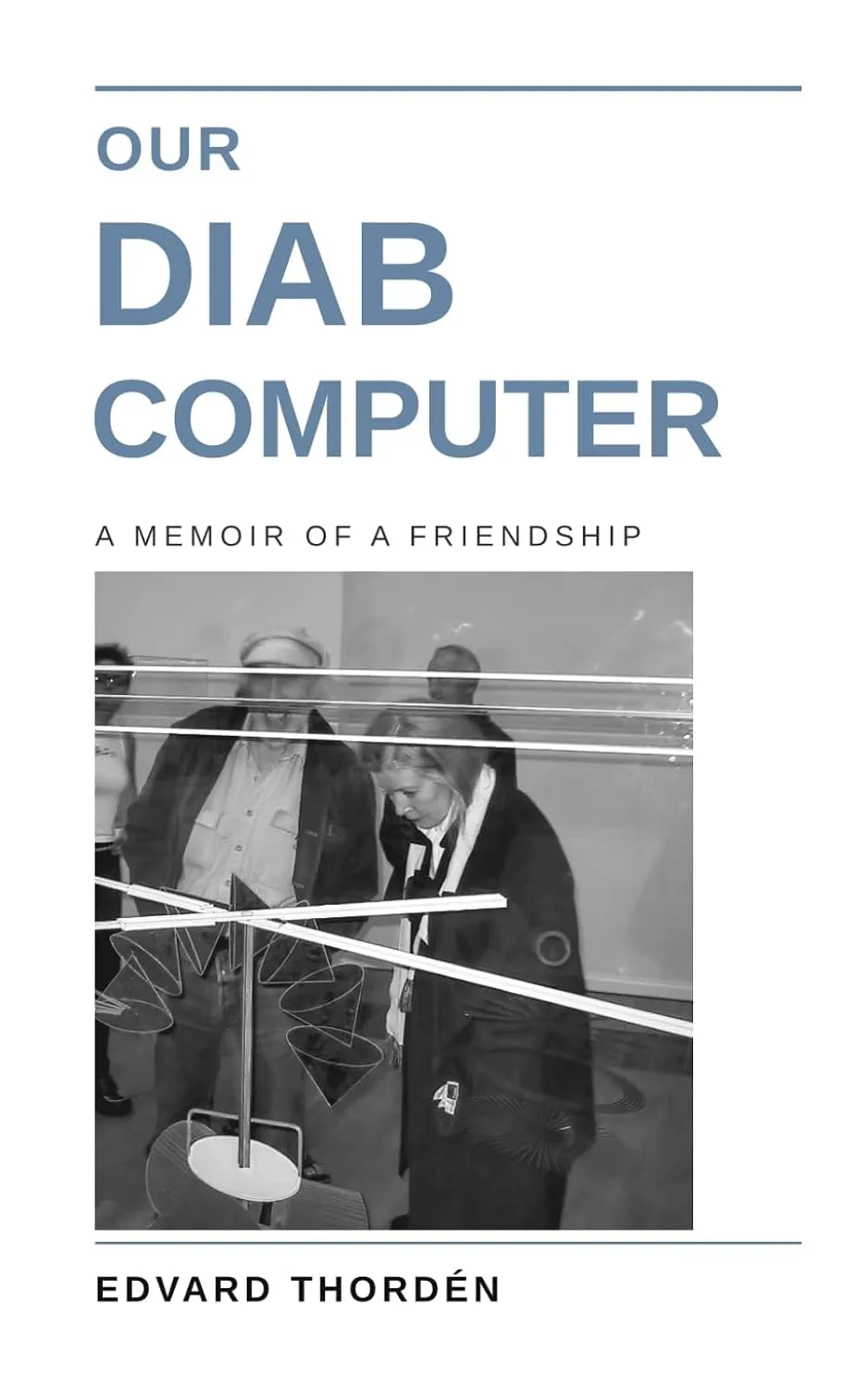
The book
Our DIAB Computer
How one of the twentieth century’s most exacting artists came to design a computer — and refused to accept that an industrial object should be ugly.
The story
Our DIAB Computer is the story of how one of the twentieth century’s most exacting artists came to design a computer — the DIAB DS 101, three stacked aluminium boxes painted in Porsche Gemini Grau, resolved on a drawing board at Northend with the same attention Hamilton gave to everything: espresso, marmalade, typography, paint. And it is the story of everything around the machine — hand-built printer cables and champagne from the cellar, lunches with Jasper Johns at Stony Point, dinners at Le Manoir and El Bulli, cigar smoke in a Swedish laboratory, summers in Cadaqués in Marcel Duchamp’s orbit, and a web server built for a Tate retrospective before the web had properly arrived.
The machine travelled: the Venice Biennale, where Hamilton’s pavilion took the Golden Lion; Documenta X in Kassel; the Tate. In 2006 a letter was sent to MoMA’s Department of Architecture and Design, proposing that a computer designed by an artist belonged in the permanent collection alongside the Bauhaus and Dieter Rams. Eventually, MoMA agreed. It is there now.
Why now
Told with the precision its subject would have demanded, Our DIAB Computer is a memoir of art, Unix, food, and friendship — and of what happens when a great artist turns his attention to an industrial object and refuses to accept that it should be ugly.
Contents
- Northend, 1980
- WordStar
- A Day at Northend
- Anthony’s Table
- Rita
- The Estate
- Altos
- The File
- Fairfield
- New York
- Linköping — The Convection Question
- Paris — Crommelynck
- The Road South
- Cadaqués
- El Bulli
- Unisoft
- Comdex, Atlanta
- The Boxes
- Teak Blocks
- Grand Hotel
Author’s note
Why I wrote this
Looking back, I realise that my life has never really been about art, computers or even books. Those have simply been the vehicles. What has always fascinated me is how ideas connect, how knowledge can be preserved, and how people from completely different worlds can inspire one another.
That curiosity has led me into extraordinary places. It brought me into the studio of Richard Hamilton, where conversations about art naturally evolved into discussions about computers, typography and design. It led me to found galleries, build software, work with collectors and museums, and, many years later, to write the story of a remarkable computer that became part of modern design history. More recently, it has inspired me to create digital tools that help patients feel more informed and confident when they meet their doctors.
I’ve never been comfortable staying within one profession. I have always been more interested in solving problems than in collecting titles. If a better catalogue was needed, I built one. If an artist needed a new way to organise decades of work, we found it. If my own experiences as a patient suggested that healthcare could become a little more understandable, that became the next challenge.
The common thread has never been technology itself, nor the art world alone. It has been people. Every meaningful project in my life has begun with a friendship, a conversation over coffee, an unexpected question or an opportunity to help someone see things differently.
If there is a philosophy behind my work, it is a simple one: good design should feel natural, good technology should almost disappear, and knowledge only becomes truly valuable when it can be shared. I have been fortunate to spend a lifetime surrounded by remarkable people. This book is, in many ways, my way of saying thank you to them.
Extract
From the opening
Northend, January 2011
eddie
thanks for the photos. i am very proud to see our diab computer so respectfully displayed in moma. what hardware? we haven’t even solved the software problems to make an update for northend.
happy new year
richard
One Northend, 1980
Alan Cristea made the introduction and drove me to Northend. I knew enough to be nervous.
Hamilton had spent years inside Duchamp’s thinking — closer than anyone alive. He had reconstructed the Large Glass from Duchamp’s own notes, translated the Green Box into English, made himself the foremost interpreter of the most deliberately uninterpretable artist of the century. My paper on that involvement was the reason I was in the car. Whether it was a sufficient reason to arrive at Northend and knock on the door was a question I had not entirely resolved.
The coffee came first. It always does in Sweden, but this was not Sweden — this was a Gaggia, a serious Italian machine that occupied its corner of the kitchen with the authority of a considered acquisition. Hamilton made espresso the way he made everything: with attention to the object, to the process, to what the thing was actually for.
Then we went upstairs.
The top floor was where the source material lived. He showed me what he had worked from — rare documents, notes, the materials of reconstruction. To see how Hamilton had moved through Duchamp’s thinking, following the logic of it, testing it against the physical reality of making the glass whole again — this was not what I had expected, which was a conversation. It was better. It was evidence.
We talked for a long time. At some point the afternoon began to darken at the windows and I understood that it was time to leave.
At the door he stopped me.
There was an Epson on his desk — a small desktop machine, a calculator really, with a printer attached. He had been told, he said, that I knew about computers. He wondered if I might have a look at it.
I looked at it. I told him the truth: this was a toy. It was not capable of serious word processing. It was not what he needed.
He looked at the Epson.
I told him I thought I could get him something better.
A month later I came back with a gift from Ohio Scientific. A large, brown, beige, clumsy box with a floppy disk drive. It filled the back seat of the car. It was, by any measure, an ugly object — the industrial logic of early personal computing with no concessions to appearance, the complete opposite of the Gaggia.
Hamilton opened the box with the focused attention he gave to everything and said nothing for a moment.
This was the beginning.
Two WordStar
It also arrived with a Facit wheel printer. Swedish made, capable of proportional printing, which in 1980 was not nothing — proportional type on a printer was the difference between a document that looked typed and one that looked almost set. Hamilton would have understood that immediately.
There was no cable.
A parallel interface requires a particular cable — many conductors, each one carrying a signal, each one needing to be correct. Serial would have been straightforward, a handful of wires and an afternoon. Parallel meant something closer to a small engineering project. Hamilton looked at the printer, looked at the computer, and said we should go to the workshop.
The workshop was well equipped. He was that kind of man — the tools were there, the materials were considered, everything had its place. We had the contacts. We did not have the cable. We found cable. We began.
It took two days.
While we worked I stayed in the guest house. Rita and Richard had designed it themselves — a small, precisely resolved space that made clear immediately that for Hamilton design was not a professional category but a way of inhabiting the world. The guest house was not decorated. It was designed, which is a different thing entirely. I understood something about him that first night that the afternoon with the Duchamp materials had not quite said.
On the second day the printer worked. A page came out — proportional type, the Facit doing what it had been made to do, the Ohio Scientific sending the signal down the cable we had built together.
We could not run WordStar. The software had not been ported to the Ohio Scientific. There were no drivers. What we had was a computer that could print proportionally and could not, in any practical sense, be used for word processing, which was the only thing Hamilton had wanted it for.
The software arrived with its owner.
Tomas Jablonski was the chief executive of Isotron, the company that owned Ohio Scientific, and he came to Northend the way American technology executives came to England in 1980 — with confidence and a solution. The word processing software was his gift, his demonstration, his answer to the problem we had not quite solved.
Hamilton invited him to dinner.
Raymond Blanc had opened Le Manoir aux Quat’Saisons not far from Northend, and it was already the kind of place that required knowing about it before it required a reservation. Hamilton knew about it. He understood restaurants the way he understood everything — as designed experiences, as arguments about what a meal could be, as objects with intentions. Tomas stayed nearby. We ate well. The conversation ranged far from floppy disks.
The next morning we all sat down to work.
Hamilton was always present for this. Not observing — present. Eager to understand what the machine was doing and why, following the logic of it, asking the questions that exposed exactly what you hadn’t explained clearly enough. He was in his sixties and had not grown up with computers and did not pretend otherwise, but he brought to the Ohio Scientific the same quality of attention he brought to everything: total, unsentimental, directed at how the thing actually worked rather than how it was supposed to work.
After some struggle the printer responded. Proportional type appeared on the page, the Facit doing its work, the software talking correctly to the Ohio at last. Hamilton looked at the page for a moment.
He went to the cellar and came back with champagne.
Tomas left the following morning. I stayed to go through the programme with Hamilton — how to operate it, what it could do, what to do when it appeared not to do what it was supposed to do. Rita made coffee. We sat in the kitchen and I could hear Hamilton upstairs, working, the machine doing what it had taken the better part of a year to make it do.
He appeared at the kitchen door with a printout. He held it up. Some characters were missing.
I looked at it.
The word processing software for the Ohio Scientific had been written in Microsoft BASIC — a practical choice and a limiting one. BASIC interpreters of that period had boundaries, functions they would not perform, instructions they did not recognise. When the software needed to do something beyond what the interpreter could handle, the programmer had gone around it: machine language routines, written directly in hexadecimal, inserted into the BASIC code through a series of PEEK and POKE commands. PEEK reads a memory address. POKE writes to one. Together they allowed a programmer to reach past the interpreter and instruct the processor directly, in its own language.
I looked at the code for a long time. It was dense with hexadecimal — raw machine instructions, addresses, values — the kind of code that has no punctuation the eye can rest on, no logic that presents itself plainly. Somewhere in one of these routines there was an error. A single wrong value, probably, writing to a memory address it shouldn’t touch, corrupting a character on its way to the printer.
I could not leave Richard with another toy.
There was no internet. There was a telephone, and Stockholm, and someone at the other end who knew the codebase well enough to talk through it. It took another day. We found the routine, identified the error, corrected the value. The printer was instructed to try again.
The characters were all there.
Hamilton held up the page and looked at it the way he had looked at the champagne bottle the night before — with a satisfaction that was precise, not expansive. He had wanted a computer that could run a word processor. It had taken the better part of a year, a cable built by hand, a dinner at Raymond Blanc, and a day on the telephone to Stockholm.
Now, he said, we can work.
Proof
Historical grounding
The DIAB DS-101 computer — designed by Richard Hamilton and at the centre of this book — is held in the permanent collections of the Museum of Modern Art, New York, and Tate, London, and travelled to the Venice Biennale, Documenta X in Kassel, and the Serralves Museum in Porto.